Laundry Detergent Fragrance vs Fabric Softener Fragrance: What Is the Difference?
In fabric care product development, many customers ask a very common question: can the same fragrance be used for both laundry detergent and fabric softener?
At first glance, both products are part of fabric care fragrance, and both are designed to make clothes smell clean and pleasant. However, from a perfumer’s point of view, laundry detergent fragrance and fabric softener fragrance are developed with different priorities.
Laundry detergent is mainly associated with the cleaning process. Its fragrance needs to remain stable in the detergent base, help mask the odor of surfactants and other raw materials, and provide a clean and pleasant impression during use. Fabric softener, on the other hand, has a stronger influence on the scent of clothes after washing and drying. This means softener fragrance usually focuses more on fabric deposition, dry fabric scent, softness association, and a more comfortable dry down.
For this reason, laundry detergent fragrance and fabric softener fragrance should not be treated as exactly the same application. The right fragrance should be selected according to the product type, formula system, target market, and the desired scent experience.
What Does Laundry Detergent Fragrance Need to Do?
Laundry detergent fragrance first needs to support the overall product experience.
When consumers open a bottle of detergent, the first thing they notice is the bottle scent. If the fragrance feels clean, fresh, and pleasant, the product is more likely to create a strong “cleaning power” impression. This is why many laundry detergent fragrances use clear and recognizable directions such as citrus, fresh floral, soapy clean notes, watery notes, green notes, lavender, white musk, or fresh fruity accents.
However, laundry detergent fragrance is not only about the bottle scent. Detergent formulas often contain surfactants, builders, enzymes, preservatives, or other functional raw materials, and these ingredients may have their own base odor. The fragrance needs to remain stable in the system while helping mask those base notes and making the overall smell more balanced.
In real product development, laundry detergent fragrance usually needs to be evaluated for:
- Stability in the detergent base
- Solubility and appearance compatibility
- Risk of turbidity, separation, sediment, or color change
- Odor masking of surfactants, enzymes, or base materials
- Scent release during washing
- Basic scent retention after washing
- Fragrance performance after storage
In other words, laundry detergent fragrance development is more focused on formula stability, washing-stage performance, and a clean product impression.
What Does Fabric Softener Fragrance Need to Do?
Fabric softener fragrance has a different role.
Softener is usually used during the rinse stage, and its interaction with fabric is different from detergent. Because of this, fabric softener fragrance often has a stronger impact on how clothes smell after washing, after line drying, or after tumble drying.
For many softener projects, customers care most about questions like these:
Do the clothes still smell nice after they are dry?
Does the fragrance feel soft, clean, and comfortable on fabric?
Does it create a pleasant fabric freshness when the clothes are worn?
This is why fabric softener fragrance usually pays more attention to the dry down and fabric impression. Common fragrance directions for softeners include:
- Powdery floral
- White musk
- Fruity floral
- Soft clean soap notes
- Floral musk
- Gentle woody musk
- Sweet floral
- Amber floral
- Perfume-inspired fabric scents
Compared with detergent fragrance, softener fragrance often places greater emphasis on the scent left on dry clothes. Floral, musky, powdery, woody, and amber notes can help create a softer and more lasting fabric impression.
At the same time, softener fragrance must also be tested in the real formula. Softener systems often contain cationic softening ingredients, and unsuitable fragrance may lead to instability, haze, separation, or an undesirable scent shift during storage.
Why Does a Laundry Product Smell Good in the Bottle but Not on Dry Clothes?
This is one of the most common questions in fabric care fragrance development.
Many laundry products smell very nice in the bottle and even smell pleasant during washing, but after the clothes are dry, the scent becomes weak or almost disappears. This does not necessarily mean the fragrance is poor. It is often a result of how the washing process works.
During washing, fragrance ingredients go through dilution, agitation, rinsing, drainage, and then drying. Many top note materials and other volatile components are easily washed away or evaporated during these stages. What remains on fabric usually depends more on the heart and base structure, and on how well the fragrance can deposit and stay on textile surfaces.
This is why the bottle scent of a detergent cannot fully predict the dry fabric scent. When choosing a laundry detergent fragrance, customers should not evaluate only the fragrance in the bottle. They should also test:
- The fragrance in the formula
- The scent during washing
- The scent on wet fabric
- The scent after clothes are dry
- The fragrance performance after storage
If the goal is a stronger and more noticeable scent on dry fabric, fabric softener fragrance or microencapsulated fragrance may be more suitable.
Why Is Fabric Softener More Suitable for Long-Lasting and Perfume-Inspired Fragrance?
Because softener is used later in the laundry process and interacts differently with fabric, it is generally better suited for dry fabric scent and long-lasting freshness.
Many brands want fabric softener to do more than simply smell clean. They want it to create a more refined and perfume-like fabric experience. This is why many softener fragrances use floral musk, powdery floral, white musk, amber musk, floral woody, rose musk, or elegant soap-inspired directions.
However, more intensity is not always better. If the fragrance is too heavy, too sweet, or too dense, the fabric may feel uncomfortable after drying. A good softener fragrance should balance scent diffusion, softness, cleanliness, and comfort.
From a perfumer’s perspective, softener fragrance needs a well-designed dry down. The opening can make the product attractive in the bottle, but the fragrance that remains on dry clothes usually comes from musks, soft florals, powdery notes, woods, and other longer-lasting materials.
When Is Microencapsulated Fragrance Useful?
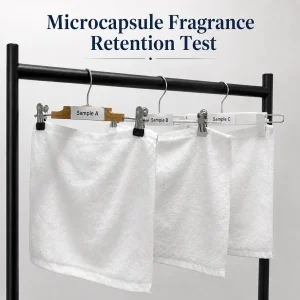
If a brand wants a stronger and longer-lasting scent on dry clothes, microencapsulated fragrance can be a very useful option.
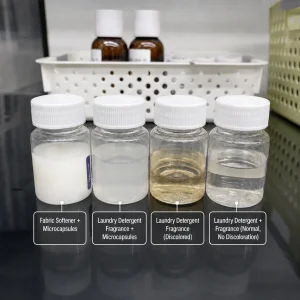
Microencapsulated fragrance uses capsule technology to protect part of the fragrance inside tiny capsules. After the fragrance is deposited on fabric and the clothes are dry, scent can be released gradually through rubbing, folding, wearing, or touching the fabric. This helps improve the long-lasting freshness experience during use.
In fabric care products, microencapsulated fragrance is often used in:
- Fabric softeners
- Scent boosters
- Laundry pods
- Premium liquid detergents
- Fabric refresher sprays
- Other long-lasting fabric care products
However, microencapsulated fragrance is not necessary for every project. It increases cost, and it also adds an extra step to the production process. In many cases, regular liquid fragrance and microcapsules are better added separately and dispersed thoroughly. For liquid detergent or fabric softener systems, microcapsules are often added at a suitable stage of the process to help achieve more even distribution and reduce the risk of clumping or poor dispersion.
So when selecting microencapsulated fragrance, customers should not only ask whether it improves scent retention. They should also consider formula compatibility, processing conditions, mixing method, equipment, product stability, and real fabric testing.
For standard detergent projects where the main goal is a pleasant bottle scent and washing-stage fragrance, regular fragrance may be enough. For products that aim for stronger dry fabric scent and scent release during wear, microencapsulated fragrance can add clear value.
Can the Same Fragrance Be Used for Both Laundry Detergent and Fabric Softener?
Some fragrance directions can be used across both products, but it is not recommended to use the same fragrance without testing.
A fragrance may perform very well in detergent, but show haze, separation, or odor change in softener. On the other hand, a fragrance that gives a soft and long-lasting dry fabric effect in softener may not perform well in detergent or may not mask detergent base odor effectively.
If a brand wants a consistent scent direction across detergent and softener, a better approach is often to develop two versions based on the same fragrance direction:
- one version optimized for laundry detergent, focusing on bottle scent, base odor masking, washing performance, and stability
- one version optimized for fabric softener, focusing on dry fabric scent, softness association, dry down, and fabric deposition
This helps keep the fragrance identity consistent while improving performance in each product system.
Fragrance Preferences in Different Fabric Care Markets
Fabric care fragrance should also be selected according to the target market.
In Southeast Asia, consumers often prefer fresh, diffusive, and more noticeable fragrance styles. Fruity floral, white floral, sweet fresh directions, tropical fruit accents, white musk, and clean soap notes are often popular.
In the Middle East and some African markets, consumers may prefer stronger and more lasting fragrance with more powdery, musky, floral, or amber character. Powdery floral, white musk, rose, amber, and stronger clean fabric scents are often well accepted.
In Europe and North America, many brands prefer a cleaner, softer, lighter, and more natural scent impression. Fresh linen, cotton, mild floral, green notes, citrus, lavender, and soft musk often fit these markets better.
These are general tendencies, not fixed rules. The final fragrance choice should still depend on the brand position, price level, formula system, and target consumer.
How Should Customers Choose Between Laundry Detergent Fragrance and Fabric Softener Fragrance?
Before choosing a fragrance, customers should first define the product type and performance goal.
If the product is laundry detergent, the key points usually include formula stability, odor masking, bottle scent, washing-stage fragrance release, and basic after-wash freshness. If the product is fabric softener, the key points usually include dry fabric scent, fabric comfort impression, perfume-like character, compatibility with the softener base, and storage stability.
Customers should also clarify:
Is the product a standard detergent, concentrated detergent, fabric softener, scent booster, or laundry pod?
Which market is it for?
Does the brand want a fresh, floral, musky, powdery, woody, soapy, or perfume-inspired direction?
Is stronger dry fabric scent required?
Is microencapsulated fragrance needed?
Are technical documents such as SDS, IFRA, COA, or allergen information required?
The clearer the project brief is, the easier it is for the fragrance supplier to recommend suitable samples and reduce unnecessary reformulation work.
How Gar Aromas® Supports Fabric Care Fragrance Development
Gar Aromas® supports fragrance development for laundry detergents, fabric softeners, scent boosters, laundry pods, and other fabric care products.
We can recommend existing fragrance directions or develop customized fragrances based on the product format, formula system, target market, scent direction, and budget range. For detergent projects, we pay more attention to bottle scent, base odor masking, washing-stage performance, and formula stability. For softener and long-lasting fabric care projects, we focus more on dry fabric scent, soft and comfortable dry down, and fragrance performance on fabric.
Depending on the project, we can also support fragrance adjustment, microencapsulated fragrance options, sample evaluation, and technical documents such as SDS/MSDS, IFRA, COA, and allergen information.
If you are developing a laundry detergent, fabric softener, or long-lasting fabric care product, contact Gar Aromas® to request sample suggestions or discuss a custom fabric care fragrance project.