How GC-MS Supports Fragrance Duplication and Cost Optimization
When a new customer sends us an existing fragrance sample, they often ask a very practical question:
“Can you analyze this fragrance by GC-MS and help us develop a similar version with a more suitable cost?”
For fragrance manufacturers, perfume brands, detergent factories, and home care product producers, this is a very common request. A customer may already have a fragrance they like, but the price is too high, the supplier is unstable, or the formula needs to be adjusted for a new market, product base, or cost level.
As a perfumer, I can say that GC-MS has changed the way we work on fragrance duplication. In the past, fragrance matching depended mainly on the perfumer’s nose, memory, raw material experience, and repeated trial work. These skills are still essential. But with GC-MS, we can now combine sensory evaluation with analytical data, which makes the whole process faster, more accurate, and more efficient.
What Is GC-MS in Fragrance Analysis?
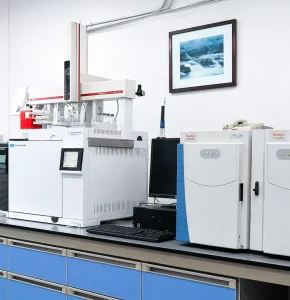
GC-MS stands for Gas Chromatography-Mass Spectrometry. In fragrance analysis, it is used to separate and identify many volatile aroma components in a fragrance sample.
Simply speaking, GC helps separate the fragrance components, while MS helps identify the possible chemical substances behind each peak. When we receive a sample, GC-MS gives us a chromatogram with many peaks. Each peak may represent one aroma compound, part of a natural essential oil, or a combination of materials with similar characteristics.
For a perfumer, this data is like a technical map. It does not replace the nose, but it gives us a clearer starting point.
Why GC-MS Is Important for Fragrance Duplication
GC-MS is especially useful when we need to understand the structure of an existing fragrance.
It can help us identify many key aroma materials, such as citrus notes, floral alcohols, musks, woody materials, aldehydes, lactones, esters, and other important fragrance ingredients. Once we understand the main structure, we can start to rebuild the fragrance direction more efficiently.
For example, if a customer sends us a laundry fragrance sample, GC-MS may help us quickly identify the main fresh, floral, fruity, musky, or long-lasting components. This allows our detergent perfumer to build a similar fragrance direction faster than relying only on smell.
For fragrance cost optimization, GC-MS also helps us compare the original sample with possible alternative raw materials. We can evaluate which materials are essential for the fragrance character, which materials can be adjusted, and which parts may be optimized according to the customer’s target price.
This is why GC-MS plays an important role in fragrance duplication, benchmark matching, and cost-controlled fragrance development.
GC-MS Improves Efficiency, But It Is Not a Complete Formula
Although GC-MS is powerful, it is important not to exaggerate its role.
A GC-MS result is not the same as a complete fragrance formula. It can show many possible components and their approximate proportions, but fragrance creation is more complex than simply copying a chromatogram.
Some materials may have overlapping peaks. Some peaks may come from synthetic aroma chemicals, while others may come from natural essential oil fractions. For example, geraniol may appear as a single aroma material, but it can also be part of natural rose oil, citronella oil, palmarosa oil, or other natural materials. Without professional interpretation, the data can easily be misunderstood.
In complex perfume fragrances, the challenge becomes even greater. A fine fragrance sample may show hundreds of peaks. Some materials are present at very low levels but have a strong impact on the odor. Some trace ingredients may be difficult to detect clearly but are important to the final character. Some base notes may be high-boiling or less volatile, which also requires experienced interpretation.
This is why GC-MS analysis must be combined with perfumer evaluation.
The Perfumer’s Nose Is Still Essential
Fragrance duplication is never only a machine-based process.
After GC-MS analysis, the perfumer still needs to smell the sample carefully, evaluate the top, middle, and base notes, understand the diffusion, dry-down, sweetness, freshness, powdery effect, musk background, and overall balance.
Then we compare the analytical result with our raw material library and formulation experience. We decide which materials are likely to be essential, which ones may be replaced, and how to rebuild the fragrance in a realistic and commercially suitable way.
This step is especially important when the customer wants not only a similar smell, but also a better cost, better stability, or better performance in a specific product base.
After the analytical review, Gar Aromas® can also support custom perfume fragrance adjustment based on the customer’s target scent profile, price level, and market positioning.
For example, a perfume fragrance and a laundry detergent fragrance are not developed in the same way. A fine fragrance may focus more on elegance, complexity, alcohol performance, and long-lasting dry-down. A detergent fragrance must consider stability in surfactant systems, wet and dry fabric odor, freshness after washing, and cost-performance balance.
Different applications require different perfumer experience.
Simple Fragrance Samples vs. Complex Perfume Formulas
The difficulty of fragrance duplication depends strongly on the type of sample.
For some detergent, fabric softener, dishwashing liquid, or home care fragrances, the formula structure may be relatively simple. If the key materials are clear and the customer’s target is practical cost optimization, the duplication process can be relatively fast.
But for fine fragrance, perfume oil, luxury personal care fragrance, or complex benchmark perfume matching, the work is usually much more detailed. The formula may contain many layers, including natural oils, aroma chemicals, fixatives, musks, floral bases, woody materials, amber notes, gourmand materials, and trace modifiers.
In these cases, GC-MS provides a strong technical foundation, but the final success depends on the perfumer’s interpretation and repeated evaluation.
How Gar Aromas® Uses GC-MS in Fragrance Development
At Gar Aromas®, GC-MS is part of our daily fragrance development workflow.
We currently operate two GC-MS machines, which support our fragrance analysis and matching projects on a continuous basis. This helps us respond faster when customers send existing samples for duplication, cost reduction, benchmark matching, or customized fragrance development.
More importantly, our work is not handled by machines alone. We have perfumers with different strengths, including fine fragrance perfumers and detergent fragrance perfumers. Each application requires a different way of thinking.
A perfume perfumer may focus more on fragrance structure, diffusion, elegance, complexity, and emotional impression. A detergent perfumer may focus more on freshness, fabric performance, stability, cost control, and long-lasting effect after washing.
By combining GC-MS analysis with application-specific perfumer experience, we can improve both speed and accuracy in fragrance matching projects.
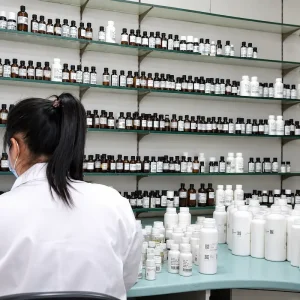
What Customers Can Send Us for GC-MS-Based Fragrance Matching
If you already have a fragrance sample and want to develop a similar version, you can send us:
- The original fragrance oil sample
- The finished product sample, such as perfume, detergent, fabric softener, body wash, candle, or air freshener
- Your target application
- Your target price range
- Your required market or regulatory direction
- Your preferred fragrance performance, such as stronger diffusion, longer lasting effect, softer profile, or lower cost
The more information we receive, the more accurately we can evaluate the sample and develop a practical solution.
For brands that need ready-to-evaluate fragrance options, our perfume concentrates can be tested in EDP, EDT, body mist, cologne, and private label perfume projects.
GC-MS Helps Us Work Faster, But Experience Creates the Final Fragrance
GC-MS has made fragrance duplication much more efficient. It helps us understand the technical structure of a fragrance sample, identify key aroma materials, and shorten the development process.
But fragrance matching is still a creative and technical process. A chromatogram can guide us, but it cannot smell like a perfumer. The final formula still needs experience, raw material knowledge, application testing, and repeated adjustment.
At Gar Aromas, we use GC-MS as a powerful tool, not as a replacement for perfumers. This combination allows us to help customers develop fragrance solutions that are not only similar in odor direction, but also practical for cost, stability, application, and market needs.
If you have an existing fragrance sample and want to develop a similar version or optimize the cost, you are welcome to send us your sample and application requirements. Our team can evaluate the fragrance structure and recommend a suitable development direction.