Lemon remains a classic scent for dishwashing liquid. Its bright, recognizable character fits the clean-kitchen experience that consumers expect. Yet a growing variety of dish soap products now use herbal, botanical, mineral, fruity and seasonal scent concepts. For brands, this creates an opportunity to build a more memorable product range without losing the functional cues associated with dishwashing.
For manufacturers and private label brands, a new scent should accomplish two things: communicate the intended brand identity and perform reliably in the actual detergent formulation. Attractive fragrance on a smelling strip is not enough.
Why Lemon Still Matters—and Why Brands Are Exploring More
Lemon and lime provide an immediate perception of freshness. They can also help balance some of the characteristic odors of a detergent base. Their familiarity makes them useful for mass-market products and cost-sensitive ranges.
However, cleaning efficacy comes from the surfactant system and the complete finished formulation—not from a citrus smell. A fragrance can reinforce the sensory impression of cleanliness, but it cannot be used as evidence of stronger degreasing performance.
Brands seeking differentiation do not need to abandon citrus. They can explore a recognizable citrus opening with a more distinctive herbal, green or aquatic background. The aim is a scent that consumers associate with the brand, rather than simply another lemon dish soap.
What Established Brands Reveal About Scent Innovation
Method: Products such as Lime + Sea Salt and Sea Minerals show how familiar freshness can be reinterpreted through marine and mineral-inspired ideas. A scent in this style may combine citrus brightness with airy, green or aromatic facets.
Mrs. Meyer’s Clean Day: Basil and Tomato Vine illustrate how kitchen herbs and leafy garden accords can offer a distinctive botanical identity. These directions are especially useful for brands that want their dishwashing product to feel connected to a wider home-care lifestyle.
Palmolive: Its 2025 limited-edition fragrance initiative demonstrated the use of seasonal concepts and broader consumer insights. Colgate-Palmolive also described an important dish soap principle: the fragrance should bloom during washing and fade rather than persist unnecessarily on dishes.
These are independent market examples, not proof that any single fragrance family will sell equally well in every country. Consumer preferences still need to be tested for the target market.
Six Dishwashing Fragrance Directions to Evaluate
| Direction | Typical scent character | Potential positioning |
| Lemon + lime | Bright and familiar | Everyday family cleaning |
| Citrus + basil | Crisp, green and aromatic | Modern kitchen care |
| Grapefruit + rosemary | Sparkling and herbal | Premium fresh collection |
| Green tea + citrus | Soft, airy and clean | Minimalist home care |
| Apple + light floral | Fresh and approachable | Seasonal or family range |
| Sea salt + watery notes | Mineral, breezy and transparent | Lifestyle-oriented dish soap |
This table is a product-development guide, not an industry sales ranking. A useful next step is to screen two or three directions against the brand’s target consumer and target fragrance cost.
A Dishwashing Fragrance Is Not a Fine Fragrance
A personal perfume is designed to create an impression on skin or clothing. Dishwashing liquid is diluted in water, agitated with surfactants and rinsed from food-contact items. Those differences change how a scent should be evaluated.
A heavy leather, gourmand or amber perfume accord can become intrusive in a kitchen-cleaning context. For most everyday dishwashing projects, freshness, balance and controlled scent release matter more than a rich, persistent dry-down. Brands targeting a special premium niche can explore more complex compositions, but the product must still feel appropriate during use.
Fragrance selection should consider three sensory moments: the bottle-opening impression, the fragrance released during foam formation, and the experience during rinsing. A strong bottle scent may be weak in lather; a mild concentrate may become brighter when diluted.
Compatibility Testing: What OEM Manufacturers Should Check
A fragrance that looks clear in a small laboratory bottle may still create haze, viscosity changes or separation in the finished product. The behavior depends on surfactants, salt level, pH, solubilization, dosage and storage conditions.
Evaluate each candidate in the actual dishwashing formula using the same fragrance concentration and processing conditions. Record:
- Bottle scent and base-odor coverage after mixing.
- Odor character and intensity during washing and foam formation.
- Clarity, discoloration, sediment or phase separation.
- Viscosity after addition and after storage.
- Fragrance character after relevant temperature and aging tests.
- Appropriate rinse-off sensory experience.
If the product is sold as a clear liquid, transparency may be a decisive acceptance criterion. Technical recommendations should be checked in the final formula rather than assumed from generic dosage ranges.
A Practical Three-Sample Evaluation Method
Ask the fragrance supplier to propose three clearly differentiated options—for example, classic lemon, citrus-herbal and green-tea citrus—at a comparable target cost. Prepare the same detergent base with each sample at the planned use level. Label the tests with neutral sample codes to reduce subjective bias.
Evaluate initial odor, performance during dishwashing, storage appearance and overall preference. Capture specific feedback such as “too sharp in lather” or “loses citrus character after storage,” instead of the unhelpful instruction “make it stronger.” This gives the perfumer actionable direction for revision.
How to Write a Better Dish Soap Fragrance Brief
A concise brief should explain the product system as well as the desired scent. For example:
Product: Transparent hand-dishwashing liquid. Market: Southeast Asia. Direction: Lime, subtle basil and green tea; fresh but not medicinal. Priority: Noticeable in-use fragrance with good bottle scent and clear appearance. Technical information: Surfactant base, pH, planned fragrance level and stability protocol. Commercial information: Target fragrance cost and expected volume.
A brand expanding its range may also develop a related scent identity for surface cleaner fragrance, but each formula requires its own technical evaluation. Explore the wider home care fragrance portfolio for other applications.
How Gar Aromas® Can Support Your Project
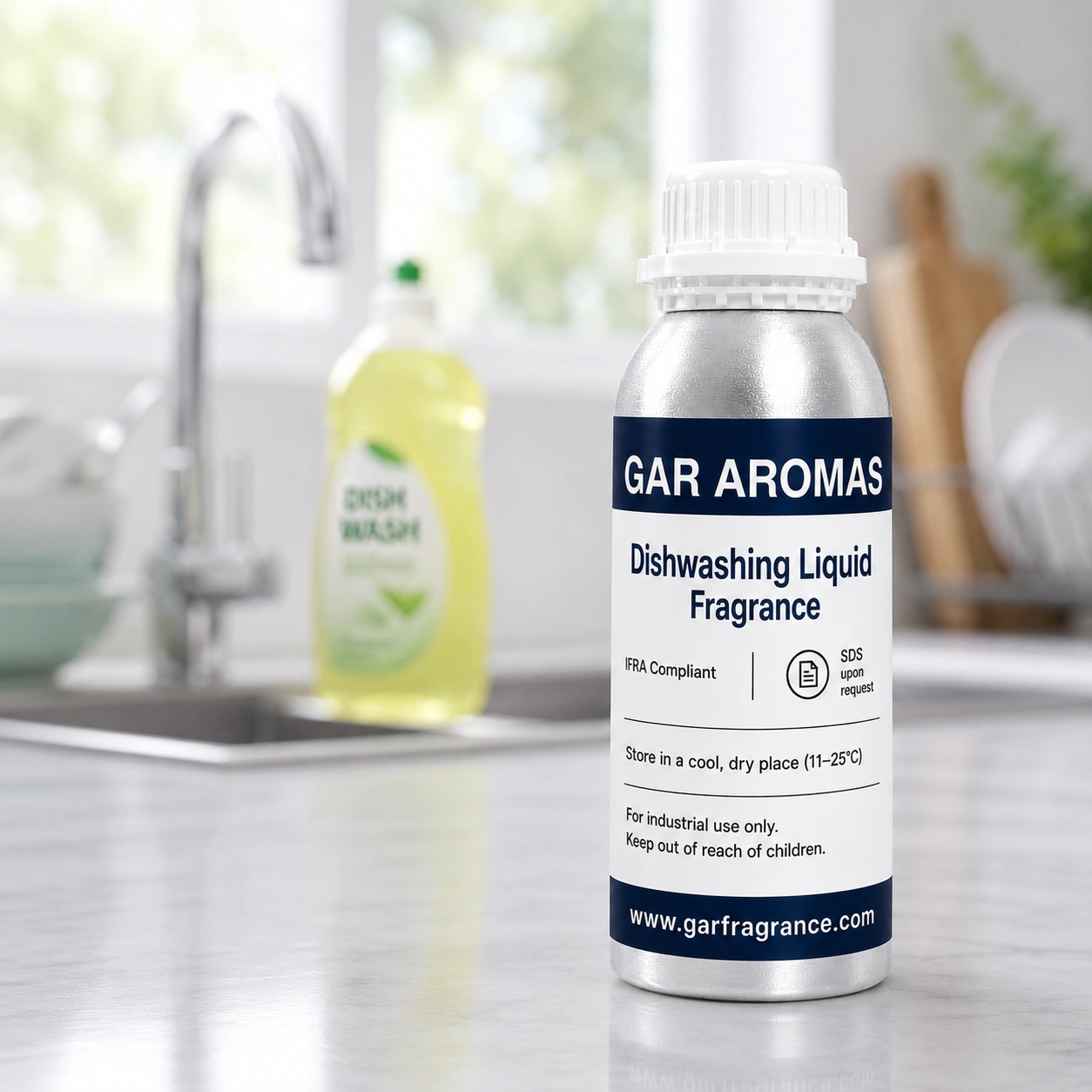
Gar Aromas® supplies dishwashing liquid fragrance concentrates for dish soap brands and household product manufacturers. We can recommend existing citrus, herbal, green, fruity and fresh fragrance directions or discuss custom scent development around a structured brief.
Our scope is fragrance concentrate supply and fragrance development, not the supply of finished dish soap, detergent bases or cleaning ingredients. We recommend evaluating candidate fragrances in the customer’s finished formulation and confirming documentation for the selected fragrance and target market.
For a new dish soap collection, share your detergent base, preferred scent direction, desired fragrance cost and expected purchase quantity. Contact Gar Aromas® to discuss fragrance samples and development options.
Frequently Asked Questions
Which fragrance is best for dishwashing liquid?
Lemon and lime remain familiar starting points, but herbal-green, green-tea citrus and watery scent directions may suit different brand positions. The best option depends on local consumer preference and compatibility with the actual dish soap formula.
Why can fragrance make dishwashing liquid cloudy?
Some fragrance materials interact with the detergent’s surfactant and solubilization system. Clarity can change with fragrance dosage, salt level, pH and temperature. Test the finished formulation before selecting a fragrance.
Can a brand use the same scent in dish soap and surface cleaner?
A shared fragrance concept can connect the collection, but the concentrates may need adaptation and separate testing because the applications and formulations differ.
Market References
- Method — Dish Soap Collection
- Meyer’s Clean Day — Dish Soap Collection
- Colgate-Palmolive — Palmolive Limited-Edition Scent Innovation (2025)
Third-party brands are discussed for independent industry analysis. No commercial partnership or endorsement by these brands is implied.