Microencapsulated Fragrance for Laundry Care
Performance, Application and Regulatory Considerations
Microencapsulated fragrance can help laundry products deliver a longer-lasting scent experience after washing and drying. For manufacturers, the result depends on the fragrance, capsule system, product formula and production process.
When selecting microencapsulated fabric fragrance, consider compatibility, addition level, dry-fabric performance and the requirements of your target market.
How Fragrance Microcapsules Work
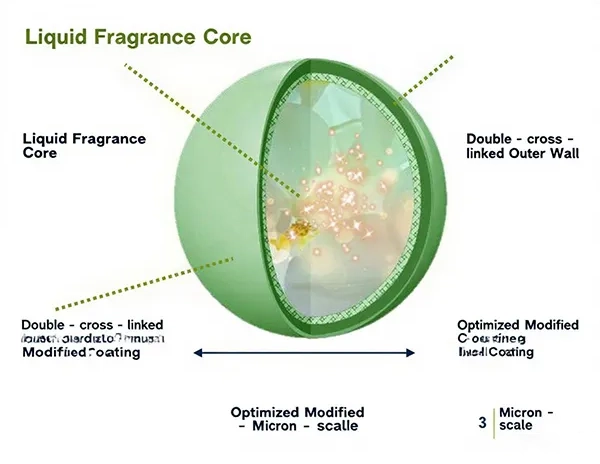
Microcapsules hold fragrance inside a protective shell. In a suitable laundry application, capsules can deposit on fabric during washing or rinsing. Friction from rubbing, handling or wearing can then break capsules and release fragrance.
Evaluate two effects separately:
- Scent on undisturbed dry fabric: the fragrance noticed without rubbing.
- Fragrance released after rubbing: the additional scent produced by mechanical action.
A strong fragrance burst after rubbing does not necessarily mean equally strong scent on untouched fabric.
Applications in Laundry and Fabric Care
Microencapsulated fragrance can be evaluated for fabric softeners, laundry detergents and other fabric-care products.
For fabric softener fragrance, dry-fabric scent and release during handling are important evaluation points. For laundry detergent fragrance, compatibility with the detergent base and performance through washing also require attention.
Powders, scent beads, concentrated liquids and pods need separate assessment. A capsule suitable for a water-based softener may require a different approach in a solvent-rich or anhydrous formulation.
For more application context, see laundry detergent fragrance vs fabric softener fragrance.
Technical Data to Compare Before Selection
Microcapsule specifications vary between products. The following reference examples illustrate differences that should be checked before formulation trials.
| Parameter | Reference Specification A | Reference Specification B |
|---|---|---|
| Reported fragrance content | Approximately 30% | 29% |
| Reported particle size | 20–25 μm | 10–30 μm |
| Shell material | Melamine resin | Melamine resin |
| Encapsulation process | In situ polymerisation | Interfacial polymerisation, as stated in the reference |
| Recommended pH range | 5–7 | 5–8 |
| PG, DPG and ethanol compatibility | Reported unstable in ethanol; PG and DPG data not specified | No PG, DPG or ethanol test results provided; reference applications are water-based |
| Anhydrous solvent-based laundry fragrance | Reported suitable; the intended solvent system requires testing | Reported unsuitable |
| Incorporation | Follow the corresponding application instructions | Water pre-dispersion recommended; confirm mixing conditions |
| Storage and shelf life | 11–25°C; 12 months | Dry area, unopened containers, optimum 11–30°C; 18 months |
These are reference specifications, rather than specifications for the entire Gar Aromas range. Confirm the fragrance-content calculation basis, particle-size measurement and application pH for the selected grade.
Technical parameters may vary by fragrance, capsule system and product specification. Applicable values, addition levels and processing conditions should follow the documentation for the selected product.
Before bulk production, confirm the available TDS, SDS/MSDS, COA and IFRA conformity documentation relevant to the intended application.
Recommended Starting Addition Level
Based on our current application experience, 0.2%—equivalent to 2‰—can provide noticeable residual fragrance in suitable laundry-care formulations. We recommend this as a starting point for application trials.
Calculate this as 2 g of the supplied microencapsulated fragrance dispersion per 1 kg of finished product, by weight.
Determine the final addition level through testing according to:
- Formulation compatibility.
- Cost target.
- Desired fragrance strength and retention.
- Capsule grade and fragrance composition.
- Actual washing, drying and fabric conditions.
Assess both undisturbed fabric scent and fragrance released after rubbing. The starting level does not establish a fixed retention period.
How to Add Microencapsulated Fragrance
Follow the instructions for the selected capsule grade and validate the process in your actual formula.
- Review the base. Check pH, surfactants, solvents and other ingredients that may affect compatibility.
- Confirm pre-dispersion requirements. Where water pre-dispersion is recommended, establish the ratio and include this water in the final formula.
- Establish processing conditions. Confirm the addition stage, temperature, impeller, mixing speed and mixing time through laboratory trials.
- Evaluate the finished product. Check dispersion, agglomeration, sedimentation, separation and changes in viscosity or appearance.
Laboratory rpm alone cannot define production-scale mixing. Equipment geometry, batch size and processing time also affect the result.
How to Evaluate Fragrance Retention and Cost
Use your actual product base and a defined control. Record the capsule grade, addition level, washing conditions, fabric type, drying method and storage conditions.
A practical evaluation can include observations:
- After the fabric has dried.
- After a defined rubbing procedure.
- At later intervals, such as days 7, 14 and 28, according to the product brief.
These are suggested observation times, rather than guaranteed retention periods. Use the same assessment procedure across samples and repeat trials where practical.
When comparing products, state whether the comparison uses equal fragrance content, equal use cost or each product’s intended dosage. Equal weights of two capsule dispersions may contain different amounts of fragrance.
Our laundry fragrance sample evaluation guide provides further guidance on organising sample trials.
Regulatory Considerations for EU Projects
Regulatory information reviewed on 23 October 2026.
Under Commission Regulation (EU) 2023/2055, the restriction on synthetic polymer microparticles used in fragrance encapsulation applies from 17 October 2029, subject to its scope, concentration threshold, exclusions and derogations.
For a degradability-based exclusion, supporting evidence must meet the relevant REACH Appendix 15 conditions. Bio-based content, biodegradability and residual formaldehyde are separate characteristics. Certain industrial information and reporting obligations can apply earlier.
Finished detergents must also meet applicable product requirements. Regulation (EU) 2026/405 on detergents and surfactants generally applies from 23 September 2029, subject to specific provisions and transitional arrangements.
Confirm free-formaldehyde data for the selected grade, including the test method and sample basis. A measured value alone does not establish finished-product compliance.
IFRA conformity documentation addresses the intended fragrance use. It does not replace a safety assessment, legal compliance or evidence concerning the capsule shell.
Industry Technology Directions
Major fragrance houses continue to develop encapsulation systems that combine fragrance performance with environmental considerations.
Examples include Givaudan PlanetCaps, dsm-firmenich popscent eco and eco max, and IFF ENVIROCAP.
These are distinct proprietary technologies. Their public descriptions highlight the value of assessing fragrance delivery, shell characteristics and supporting documentation together when selecting a product.
Frequently Asked Questions
Can one microcapsule grade work in every laundry formula?
Suitability depends on the capsule grade and finished formula. Detergents, softeners, powders and concentrated products require their own compatibility and application testing.
Can encapsulated and free fragrance be used together?
They can be evaluated together to support different stages of the scent experience. Establish their balance through fragrance assessment, stability testing and cost evaluation.
How long will the fragrance last on fabric?
Retention depends on the fragrance, capsule system, dosage, fabric, washing, drying and storage conditions. Confirm performance using an agreed test procedure.
Discuss Your Project with Gar Aromas
Gar Aromas is expanding its microencapsulated fragrance options for fabric-care applications.
To discuss samples for your project, share your product type, base information, target market, preferred scent, production process and cost target. Describe the effect you want on undisturbed dry fabric and after rubbing so that suitable samples can be selected for evaluation.