Learn what a perfume accord is and how fragrance accords are created. A perfumer explains the structure behind fragrance composition and perfume development.
Introduction — A Question Many Perfume Brands Ask
When brands begin developing a new fragrance, one of the most common questions they ask is surprisingly simple:
“How is a perfume actually built?”
Many perfumers use classification systems such as the fragrance wheel developed by Michael Edwards to position the scent within a broader fragrance family.
Understanding how fragrance accords work helps perfume brands communicate better with perfumers and makes fragrance development far more efficient.
What Is a Perfume Accord?
Many people search for “what is a perfume accord” when learning about fragrance creation.
In perfumery, a perfume accord is a blend of several ingredients that together create a completely new scent impression. The individual ingredients may be recognizable on their own, but when combined in the right proportions they form a unified fragrance profile.
A useful way to understand a fragrance accord is through music:
-
Individual materials are like musical notes
-
An accord is like a chord
-
The finished perfume is the full composition
For example, a classic rose accord might include materials such as:
-
Phenethyl alcohol
-
Citronellol
-
Geraniol
-
Small green or spicy modifiers
Individually these ingredients smell simple, but together they recreate the complex impression of a blooming rose.
Fragrance accords are therefore the building blocks of perfume composition.
How Perfumers Create Fragrance Accords
Creating a fragrance accord is both technical and creative. Perfumers typically follow several important steps when building an accord.
Step 1: Defining the Olfactive Direction
Before writing any formula, the perfumer defines the overall olfactive direction of the fragrance.
Examples include:
-
floral
-
woody
-
citrus
-
amber
-
green
Many perfumers use classification systems such as the fragrance wheel developed by Michael Edwards to position the scent within a broader fragrance family.
This shared framework helps perfumers, brand owners, and evaluators communicate clearly about fragrance style.
Step 2: Selecting the Core Raw Materials
Once the olfactive direction is clear, the perfumer selects the key materials that will form the identity of the fragrance accord.
Examples include:
Rose Accord
Common materials may include:
-
Phenethyl alcohol
-
Geraniol
-
Citronellol
Citrus Accord
Typical components include:
-
Lemon oil
-
Bergamot oil
-
Aldehydes
Woody Accord
Typical materials include:
-
Cedarwood notes
-
Sandalwood molecules
-
Amber materials
These ingredients form the central body of the fragrance composition.
Step 3: Balancing the Fragrance Structure
After selecting the core materials, the perfumer begins adjusting proportions to create a balanced accord.
Three factors are especially important:
Diffusion
How strongly the fragrance projects into the air.
Texture
Whether the scent feels soft, creamy, bright, dry, or powdery.
Longevity
How long the accord remains detectable on skin or fabric.
Creating the right balance often requires multiple iterations and extensive smelling.
The Role of Natural and Synthetic Ingredients
Modern fragrance accords usually combine both natural extracts and synthetic aroma molecules.
Natural materials such as jasmine absolute, rose oil, or neroli provide complexity and richness. However, they can also present challenges including:
-
price volatility
-
seasonal availability
-
regulatory restrictions
Synthetic ingredients help perfumers solve these problems by offering:
-
consistent quality
-
improved stability
-
precise olfactory control
For this reason, most contemporary perfume accords are hybrid compositions that combine natural and synthetic materials.
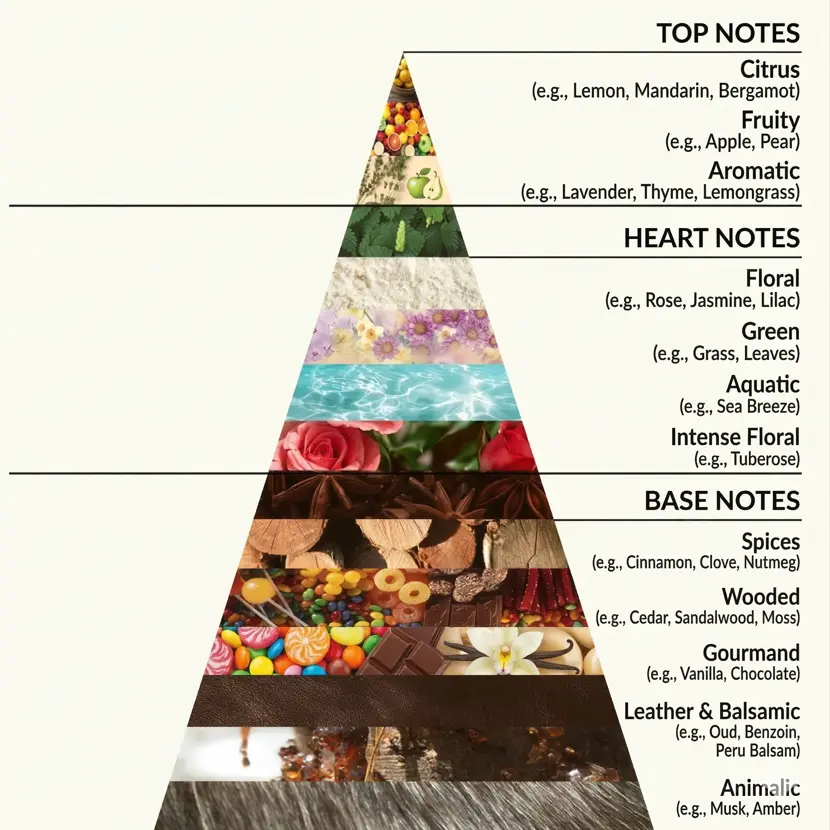
How Fragrance Accords Fit Into the Perfume Pyramid
Once the fragrance accord is built, it becomes part of the overall fragrance composition structure.
Most perfumes follow a three-layer architecture known as the fragrance pyramid.
Top Notes
These are the first scents perceived after application.
Common examples include:
-
citrus notes
-
aldehydes
-
green notes
Heart Notes
The heart notes define the main personality of the perfume.
Most floral accords appear in this middle layer.
Base Notes
The base provides depth and longevity.
Typical base materials include:
-
musk
-
woody notes
-
amber materials
A well-designed perfume ensures that these layers evolve smoothly over time.
Why Perfume Accords Matter in Fragrance Development
For perfume brands and fragrance manufacturers, fragrance accords provide several practical advantages.
Clear Communication
Accords make it easier to describe fragrance concepts during product development.
Faster Development
Perfumers can build new fragrances more efficiently by starting from proven accord structures.
Better Stability
Accords can be optimized to perform consistently across different applications.
Scalable Production
Accord-based formulas remain more stable during large-scale manufacturing.
Because of these advantages, fragrance accords remain one of the most essential tools in professional perfumery.
Conclusion
Perfume creation may appear mysterious, but it is built upon a clear structural logic.
Fragrance accords allow perfumers to transform abstract ideas—such as elegance, freshness, or warmth—into precise and reproducible fragrance compositions.
For brands developing new fragrances, understanding how accords work makes collaboration with perfumers more efficient and helps ensure that the final scent is both technically reliable and emotionally engaging.