Introduction — A Question Every Brand Eventually Asks
When working with perfume brands and OEM manufacturers, one question inevitably comes up:
“What fragrance concentration should we use?”
Many expect a number.
15%? 20%? 5%?
But fragrance concentration is not a marketing decision.
It is a structural engineering decision.
Choosing the wrong concentration can result in:
-
Alcohol cloudiness
-
Emulsion instability
-
Skin sensitivity issues
-
Reduced projection
-
Higher raw material cost without performance gain
-
IFRA non-compliance
In professional fragrance development, concentration defines the balance between diffusion, stability, compliance, and commercial viability.
What Fragrance Concentration Really Means
Fragrance concentration refers to the percentage of fragrance oil within the final product formulation.
But that percentage behaves differently depending on:
-
Solvent system
-
Volatility curve
-
Application environment
-
Regulatory category
-
Consumer expectation
The same 15% can perform elegantly in one system and fail in another.
1️⃣ Alcohol-Based Perfume Systems (EDP / EDT)
Typical Ranges:
-
Eau de Toilette (EDT): 8–12%
-
Eau de Parfum (EDP): 15–20%
-
Extrait de Parfum: 20–30%
However, percentage alone does not determine performance.
Critical factors include:
-
Ethanol purity level
-
Solubility curve of aroma chemicals
-
Fixative structure
-
Evaporation layering
Higher concentration can sometimes:
-
Compress top note brightness
-
Overweight base notes
-
Reduce elegant diffusion
For structured high-strength systems, engineered perfume cores such as our High-Performance Fragrance Solutions are typically recommended.
2️⃣ Personal Care Systems (Lotions, Creams, Body Mist)
Typical Ranges:
-
Leave-on products: 0.2% – 1%
-
Rinse-off products: 0.5% – 3%
Key Constraints:
-
IFRA category limits
-
Allergen labeling thresholds
-
Emulsion compatibility
-
Surfactant interaction
-
Oxidation behavior
In personal care, concentration is governed more by safety and regulatory compliance than by projection strength.
Increasing percentage without reformulation can destabilize the entire system.
3️⃣ Home Fragrance & Candle Applications
Typical Ranges:
-
Reed Diffusers: 10–25% fragrance load (in solvent base)
-
Candles: 5–10% fragrance load
-
Room Sprays: 2–5%
Performance Factors:
-
Flash point
-
Heat stability
-
Wax binding compatibility
-
Cold throw vs hot throw behavior
A perfume-grade fragrance may not perform effectively in wax without structural modification.
Application determines concentration viability.
The Engineering Behind Concentration Decisions
In professional fragrance formulation, we evaluate:
-
Molecular weight distribution
-
Volatility ladder alignment
-
Diffusion radius
-
Fixative anchoring
-
Stability under heat and UV exposure
-
IFRA maximum dosage limits
Fragrance concentration is not simply about intensity — it is about system harmony.
Case Example: When Increasing Percentage Fails
A niche perfume client once increased concentration from 18% to 22% hoping for stronger longevity.
Result:
-
Projection decreased
-
Base notes became heavy
-
Formula stability dropped
Why?
The volatility curve was compressed.
The scent lost airiness.
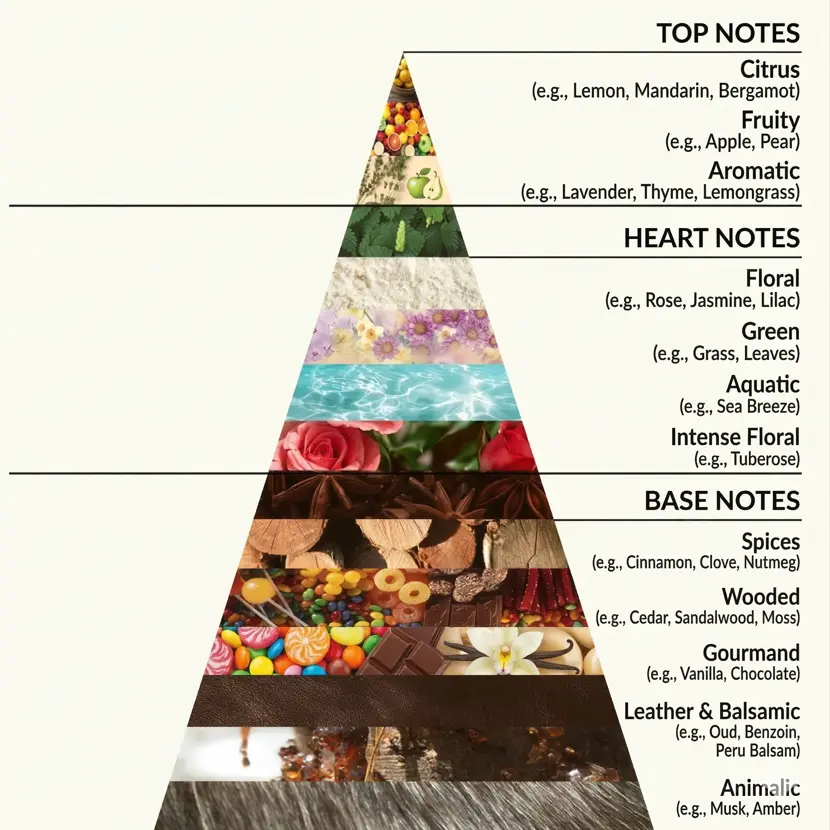
After restructuring the olfactive pyramid instead of increasing dosage, performance improved significantly — without raising concentration.
Structure beats percentage.
Market Positioning vs Concentration
Luxury positioning does not always require higher percentage.
Consumers associate quality with:
-
Evolution complexity
-
Balance
-
Diffusion elegance
-
Skin comfort
In emerging markets, excessive concentration can even reduce acceptance due to climate conditions.
Humidity, temperature, and cultural preferences influence ideal strength.
Concentration must align with target market behavior.
Regulatory & Compliance Considerations
Before defining the final concentration, it is essential to reference the latest standards issued by the International Fragrance Association (IFRA), which establish maximum usage levels according to product category
Exceeding these limits can result in:
-
Export rejection
-
Labeling issues
-
Legal risk
Before defining concentration, always verify:
-
IFRA category
-
Regional cosmetic regulations
-
Allergen declaration thresholds
For compliance-driven projects, our Functional & Alcohol-free Fragrance Systems often provide optimized solutions.
How We Determine the Right Concentration in OEM Projects
In structured OEM development, we follow three evaluation layers:
1️⃣ Application First
Alcohol? Emulsion? Wax? Hybrid system?
2️⃣ Market Positioning
Luxury niche? Mid-market? Sensitive skin? Mass retail?
3️⃣ Performance Objective
Longevity? Projection? Cost control? Regulatory simplicity?
Only after these factors are defined do we determine concentration range.
For customized positioning strategies, our Custom Fine Fragrance Development service supports structured decision-making.
Common Mistakes Brands Make
-
Copying competitor percentage blindly
-
Assuming higher percentage equals better quality
-
Ignoring solvent system compatibility
-
Overlooking IFRA limits
-
Increasing fragrance load to compensate for weak structure
Fragrance performance is an architectural outcome, not a numerical adjustment.
Conclusion
There is no universal fragrance percentage.
The right concentration is determined by:
-
System compatibility
-
Volatility structure
-
Regulatory framework
-
Target market climate
-
Brand positioning
In professional fine fragrance development, structure always comes before strength.
Need Guidance on Fragrance Concentration Strategy?
If you are planning a new perfume launch, OEM production program, or multi-format fragrance line, our technical team can help evaluate the optimal concentration structure for performance, compliance, and commercial balance.
[Discuss Your Project with Our Technical Team]