Understanding Candle Fragrance Oil Discoloration
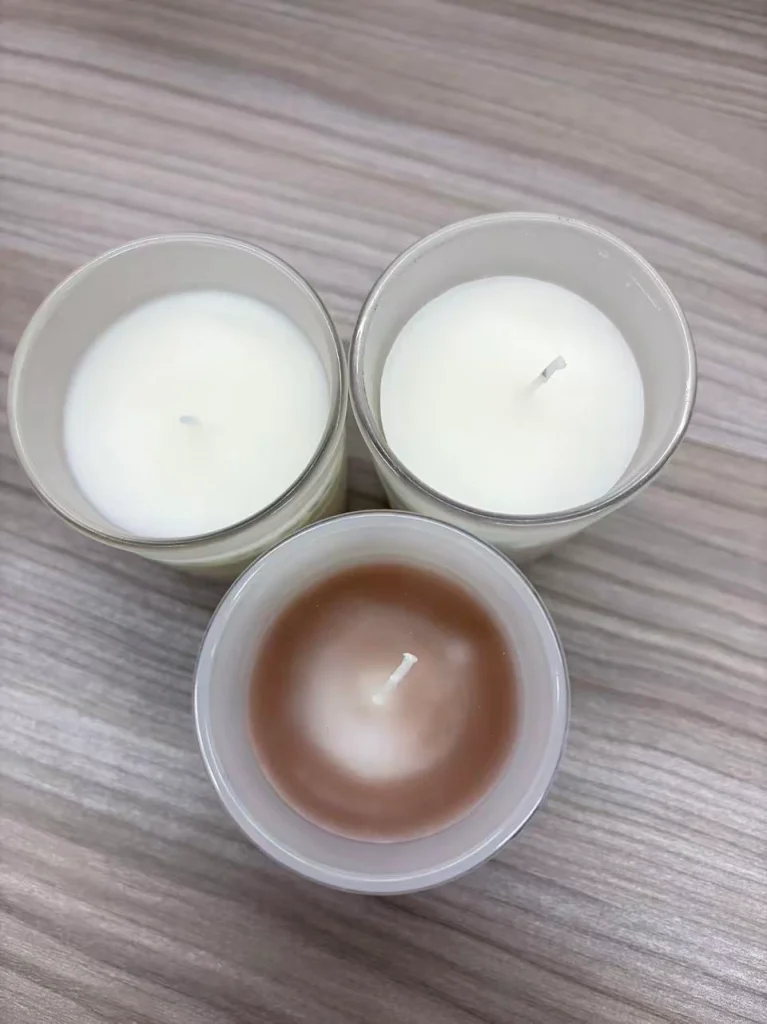
Color change is a common issue in scented candle manufacturing. Sometimes, even when the same candle fragrance oil is used by the same customer, the finished candle may show yellowing, darkening, or uneven discoloration.
Recently, we encountered this situation in a cup candle project. The fragrance oil smelled stable and attractive, but after being added into the candle wax system, the finished candle showed visible color change compared with the original sample.
So, why does candle discoloration happen?
Fragrance Oil Can Be One Possible Factor
Candle fragrance oil is a complex mixture of aroma materials. Some fragrance ingredients are naturally more sensitive to light, oxygen, heat, or interaction with wax.
For example, fragrance materials used in vanilla, gourmand, citrus, spice, amber, or certain natural extract profiles may have a higher chance of causing yellowing or darkening in wax. This does not always mean the fragrance oil is low quality. In many cases, the scent performance, cold throw, and hot throw may still be good, but the appearance of the finished candle changes during storage or aging.
This is why candle fragrance oil should not only be evaluated by scent in the bottle. It should also be tested in the actual wax base before mass production.
Wax System and Production Conditions Also Matter
The same fragrance oil may behave differently in different candle wax systems. Soy wax, paraffin wax, blended wax, coconut wax, and other specialty wax bases all have different melting points, oil absorption, color stability, and compatibility behavior.
Candle discoloration is usually not caused by one single factor. It may be related to:
- Fragrance oil composition
- Wax type and wax quality
- Fragrance dosage level
- Pouring temperature
- Dye or pigment interaction
- UV light exposure
- Storage temperature
- Oxidation during aging
- Iron ions or metal-containing impurities
- Contact with unsuitable metal containers, tools, or raw material residues
- Differences between production batches
In our experience, when the same candle fragrance oil shows different color results, it is important to compare the full production conditions, not only the fragrance formula.
Iron Ions May Accelerate Candle Discoloration
Iron ions or metal-containing impurities can also increase the risk of candle discoloration. In some cases, trace metal contamination from raw materials, production tools, containers, pigments, additives, or processing equipment may accelerate oxidation in wax or fragrance systems.
This can lead to yellowing, browning, darkening, or uneven color change in finished scented candles.
For this reason, when discoloration appears, candle manufacturers should check not only the fragrance oil, but also the wax source, colorants, additives, containers, production tools, and storage conditions.
How to Reduce the Risk of Candle Discoloration
To reduce the risk of color change in scented candles, we recommend:
- Test the candle fragrance oil in the actual wax base before production.
- Keep stability samples for comparison.
- Observe candle color after 24 hours, 7 days, and longer storage.
- Avoid strong light and high-temperature storage.
- Check whether dyes, pigments, or additives affect color stability.
- Avoid possible metal contamination from tools, containers, or raw materials.
- For white or light-colored candles, choose fragrance directions with better color stability.
- Work with the fragrance supplier to adjust the formula when needed.
A good candle fragrance oil should not only smell attractive. It should also support stable performance in the finished candle, including wax compatibility, scent diffusion, cold throw, hot throw, and appearance stability.
Gar Aromas® Candle Fragrance Support
At Gar Aromas®, we supply candle fragrance oils for scented candle brands, home fragrance manufacturers, and private label candle projects.
When developing candle fragrance oils, we consider not only the scent profile, but also candle wax compatibility, cold throw, hot throw, diffusion, and fragrance stability in finished candles.
If you are developing a scented candle collection, you can learn more about our candle fragrance oil solutions or contact Gar Aromas® to request samples for wax compatibility testing.